-
Categories
| Model | 56 |
| Boat type | Other |
| Category | Motor Yacht |
| Displacement | 15.3 t |
| Engines | 1 |
| Fuel | Other |
| Year built | 2006 |
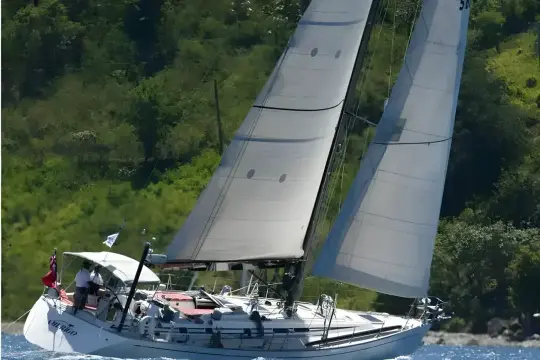
RUNAWAY BUNNY, formerly known as LORETTA, is currently with her third owner. She is hull #003 of six 56s constructed in the early 2000s by the renowned Baltic Yachts yard in Finland.
Since 1974, Baltic Yachts has been producing exceptionally high-quality sailing yachts and continues to build vessels today, up to 175 feet in length.
This Baltic 56 was designed as a fast, safe offshore boat. For the past five years, RUNAWAY BUNNY has served as a family sailing boat. Equipped with a swept spreader rig, electric winches, a German mainsheet system, a powerful autopilot, and a double companionway, she is easy to sail short-handed.
With her carbon construction, carbon mast, long waterline, and powerful rig plan, RUNAWAY BUNNY is an exceptional performance cruiser capable of achieving 200-mile days even in moderate breezes. In optimal conditions, sailing speeds have been recorded at over 20 knots!
As the family is now growing older, it is time to pursue other ventures. RUNAWAY BUNNY has been meticulously maintained and is ready for her next adventure.
The white gel-coated hull is constructed using advanced composite materials, including carbon and epoxy vacuum bagged sandwich laminates that are post-cured for optimal strength. Main reinforcements in all laminates are unidirectional and multi-axial carbon. The hull's outer skin incorporates layers of aramid fibers for enhanced impact resistance and safety.
Structural bulkheads and small furniture panels are made on a heated flat-panel laminating table with vacuum consolidated laminates cured at 80°C to 85°C. The sandwich material used is Core-Cell or Divinycell.
Composite main chainplates are integrated into the bulkheads and hull laminates.
Engine beds are incorporated into the hull and laminated over a PVC core.
The mast step is a fabricated aluminum alloy unit bolted to reinforced floors and stringers, adjustable fore and aft.
Features include a fin keel with stainless-steel construction and lead bulb, a cantilevered, semi-elliptical, balanced spade rudder made of carbon and filled with PVC foam, and a tapered rudder stock to reduce weight, made of carbon and epoxy, passing through two self-aligning bearings.
The transom folds down to create a swim platform and provides access to the dinghy garage in the stern.
A detachable stainless-steel swim ladder connects the swim platform to the water.
Additionally, there is a retractable Max Power bow thruster.
The deck is constructed using advanced composite materials with epoxy vacuum bagged sandwich laminates that are post-cured for maximum strength. Main reinforcements are unidirectional and multiaxial carbon, with high-load areas strengthened with additional laminate.
Features include locker lids at the bow for accessing the anchoring system, an anchor housed on a hinging anchor arm operated manually, a Lewmar 24V electric anchor windlass with chain and rode gypsy, and a flush-mounted electric mooring winch on the foredeck.
There is a locker lid aft of the anchoring system for accessing a large sail locker, stainless-steel bow and stern rails, stainless-steel stanchions with double lifelines, lifeline gates on both port and starboard sides, and stainless-steel handrails at the main companionway.
Spray hoods are provided for both forward and aft companionways, and there is a teak overlay, vacuum bagged using epoxy, on the side decks, cockpit floor, seats, and coamings.
Additional features include a stainless-steel stem head fitting with anchor roller, a pair of genoa tracks with two cars and control lines, three pairs of pop-up mooring cleats, three pairs of mooring line fairleads, Spinlock line jammers, fixed tempered glass windows in the coachroof, tempered glass sliding hatches over companionways, washboards for companionways, a mainsail track with traveler, double turning foot-blocks for headsail sheets, stand-up blocks at mast partners for halyards and topping lifts, and two 5lb propane tanks stored in a dedicated compartment in the port aft storage garage.
Double steering pedestals with titanium wheels, each covered with elkhide, and a hot and cold-water deck shower in the aft storage garage complete the deck features.
All winches are Lewmar and self-tailing:
Accommodates 6 people, with 2 in each of the 3 sleeping cabins, and 2 more in the main saloon for a total of 8. There are 2 heads. The interior features varnished and hand-rubbed satin finish teak furniture with a teak and holly cabin sole and vinyl overhead ceiling panels.
Located in the bow, accessible from either the master cabin head on the aft side or above from the deck.
Located immediately aft of the storage locker and forward of the master cabin, accessed from the master cabin and storage locker. Molded fiberglass and gel-coated units to half height, with an electric head and sink to port and shower area to starboard with a teak shower seat.
Located aft of the master cabin head, featuring a double pullman bunk top port, aircraft overhead lockers port and starboard, a hanging locker aft to starboard, and a bench seat forward to starboard.
Located aft of the master cabin, with a settee to starboard, an “L” shaped settee to port surrounding the dining table, and a double seat on centerline with an adjustable backrest allowing guests to sit at the table or facing the starboard settee. Lockers and shelving are outboard to port and starboard, with the companionway steps to the forward cockpit located aft and on the centerline.
Located aft of the main saloon on the port side, designed in a “U” shape for maximum security at sea. Features include Corian countertops, an Inox stainless-steel, 4-burner propane stove with oven and grill, an LG microwave oven, Isotherm ASU refrigeration with twin tops to stainless-steel lined fridge and freezer units, and double stainless-steel sinks aft.
Aft of the main saloon on the starboard side, featuring a walkway aft passing a countertop. Engine access, lockers, and heated hanging wet lockers are in the walkway to the navigation station, which is on the centerline facing forward. The port side of the navigation desk contains the electrical panel, with navigation instruments on the bulkhead forward. Companionway steps to the aft cockpit are located immediately aft of the navigation station.
Located to starboard of the navigation station.
Located to port of the navigation station, featuring an electric head.
Located aft of the navigation station on the port and starboard sides, these cabins are mirror images of each other, featuring 2 x single bunk beds outboard in each cabin. The upper bunk bed can be removed and fitted to the lower bunk bed to create a double. Each cabin includes a seat aft and inboard, and a hanging locker forward and outboard.
Yanmar 4JH3-HTE, 100hp (at 3800rpm), 4-cylinder turbo diesel.
Fresh water cooled.
Dual Racor water/fuel separator in fuel line.
MHH 4-A transmission.
Stainless-steel propeller shaft with line cutter fitted.
Morse single lever control.
HMI water-cooled exhaust system exiting beneath the waterline.
Engine room blower.
Cruising speed at 2000rpm approximately 7.5 knots.
Fuel consumption at cruising speed approximately 5 liters per hour.
3 blade, variable pitch, Gori propeller.
13-gallon stainless-steel water heater, heating off engine or AC.
New Grocco pumps and pressure tanks supply hot and cold pressure water system, heads, stall shower, deck shower, and galley.
Sea water deck wash.
Fresh water tanks are made of stainless-steel.
Spectra Newport 400 water maker.
3 x high-capacity Jabsco Par electric bilge pumps with manual override switch at navigation station servicing the forward storage area, main bilge, and lazarette.
2 x manual bilge pumps, 1 in cockpit and 1 in saloon.
Black water tank with Tankwatch 4 monitoring system for each head, with deck and overboard discharge.
Dorade vents on deck, opening deck hatches, and opening deck ports.
Dometic 18,000 BTU air conditioning (2025).
Eberspacher diesel forced air heating.
Exhaust fan over stove in galley.
Engine room blower and exhaust.
80A 12V alternator for start batteries.
175A 24V alternator for house batteries.
230V, 50Hz, AC system.
Modified deck AC plug to additionally receive 120V/240V, 60Hz shore power in the US.
50A shore power cord.
24V, DC, house system.
12V, DC engine start system.
4 x AGM 8D, 12V house batteries wired in series to provide 24V (2022).
12V engine start battery.
12V generator start battery.
2 x 12V bow thruster batteries wired in series to provide 24V.
Northern Lights 5kW generator (2024).
Inverter, Mastervolt Mass 24/2500.
Battery charger, Mastervolt 100A.
2 x Solbian Flex Solar panels.
AC outlets throughout.
Interior lights include:
Exterior lights include:
B&G autopilot (2020).
Raymarine radar with scanner on mast.
Raymarine hybrid touch navigation display.
GPS chart plotter.
4 x Raymarine displays on mast under goose neck.
Raymarine displays at navigation station and forward cabin.
Raymarine RayMic 260E VHF.
West Marine handheld VHF.
Iridium connection port at navigation station.
Stereo.
Hall Spars carbon mast and boom painted white.
Triple swept aft spreader.
Antal mainsail track.
Trysail track (2021).
2:1 main halyard system.
Mast steps at base of mast for easier access to mainsail head.
Stainless-steel rod standing rigging (2020).
Removable inner forestay for staysail with tensioner.
Checkstays.
Carbon spinnaker pole and jockey pole, stored on deck, painted white.
Reckmann headsail roller furling with removable drum for racing.
Carbon fiber luff foil for headsails.
Navtec hydraulics for vang, mainsail outhaul, and backstay.
Lazyjacks.
German mainsheet system.
All new in 2022 except as noted:
572.901,90 $
568.309,50 $
568.309,50 $
568.309,50 $
562.569,00 $
562.569,00 $
556.828,50 $
591.271,50 $
551.088,00 $
597.012,00 $
538.458,90 $
533.866,50 $
528.126,00 $
527.551,95 $
526.977,90 $
526.977,90 $
516.645,00 $
516.645,00 $
630.306,90 $
631.455,00 $
1.445.000,00 $
325.000,00 $
425.000,00 $
3.996.000,00 $
499.000,00 $
179.000,00 $
1.249.000,00 $
474.900,00 $
299.000,00 $
995.000,00 $
1.149.000,00 $
699.000,00 $
879.000,00 $
675.000,00 $
479.000,00 $
399.000,00 $
1.149.000,00 $
999.000,00 $
1.190.000,00 $
624.999,00 $